The Home Features Buyers Say They Want — And What They Actually Choose

Buyers come to me with lists. Smart home features, open floor plans, home offices, energy-efficient systems. And I take those lists seriously — but after more than 20 years of helping people buy and sell homes across the Bay Area, I've learned something that no checklist captures: the home someone chooses is almost never the home they described wanting at the start.
That gap is not a problem. Understanding it is exactly what good representation is for.
Key Takeaways
- Neighborhood quality is the number one purchase driver — consistently, across every buyer profile and price point
- Buyers who say they want a project almost always choose move-in ready when the moment comes
- The open floor plan preference is more complicated than most buyers realize before they start touring
- Emotional response at the showing, not the feature checklist, drives most final decisions
- The homes that sell fastest are the ones where buyers can immediately picture their life — not just evaluate the specs
What Buyers Say They Want
Before the first showing, most buyers can describe their ideal home in confident, specific detail.
Energy efficiency and smart home technology. According to NAHB's What Home Buyers Really Want survey, ENERGY STAR-rated windows and appliances, whole-home energy ratings, and smart home systems are consistently rated as essential or highly desirable. These come up early in buyer conversations — and with real conviction.
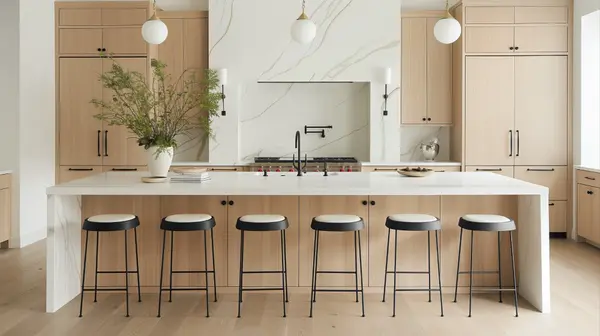
An open floor plan. This has been the default answer for so long that many buyers state it without thinking. The merged kitchen-living-dining space became cultural shorthand for "modern" — and buyers absorbed it as a preference before they ever tested it against how they actually live day to day.
A dedicated home office. Post-pandemic work habits made this a genuine priority for a large share of buyers. Not a desk in a corner — a real room with a door that closes.
Renovation potential. Particularly among buyers working with a tighter budget, the fixer-upper framing sounds financially smart. Get in at a lower price, build equity through improvements. The logic holds up on paper. Living through it is a different experience.
What Buyers Actually Choose
This is where the list starts to matter less than the person holding it — and where having an experienced agent in your corner makes a real difference.
Neighborhood over everything
The National Association of Realtors surveys actual recent buyers — not aspirational ones, but people who have already signed and closed — about what most influenced their final decision. According to the NAR 2025 Profile of Home Buyers and Sellers, 59% named quality of neighborhood as their top factor. Not the kitchen renovation. Not the smart home system. Not the layout. The street, the feel of arriving home, the sense that this is a place where life will actually be good.
Proximity to friends and family came in at 47%. Convenience to work — the factor that used to organize everything — had dropped to just 31%, down from 52% a decade earlier.
That shift matters. Buyers are no longer optimizing primarily for the commute. They are optimizing for the life. And when a home feels right in that deeper sense — when the neighborhood answers something a buyer didn't even know they were asking — they will overlook features they swore were non-negotiable. When it doesn't feel right, no feature list saves it.
I've watched buyers talk themselves out of objectively better homes because the street didn't feel right. And I've watched them stretch well past their stated budget because a neighborhood answered something they couldn't quite articulate. That instinct is worth listening to. Part of my job is helping buyers trust it.
Move-in ready, almost every time
According to the NAR 2025 Profile of Home Buyers and Sellers, 88% of buyers purchased previously owned homes, with affordability as their primary reason. Only 12% chose new construction — and their main motivation was avoiding renovation work altogether.
What I see consistently across two decades of transactions: the buyers who enter the search most enthusiastic about a project are often the ones who feel most relieved when they find a home that doesn't need one. The renovation plan makes sense financially until it has to become a real plan — contractors, timelines, material decisions, disruption, all stacked on top of a new mortgage and a move. At that point, the calculus changes fast.
A home that is clean, well-maintained, and genuinely ready to live in communicates something that no amount of "potential" can replace. It tells a buyer that the people who lived here cared. Buyers feel that. It affects what they offer and how quickly they decide.
Comfort over prestige
Buyer preferences have shifted away from homes designed to impress and toward homes designed to support how people actually live. NAHB research consistently shows buyers prioritizing functional layouts, usable outdoor space, and practical storage over grand finishes that don't improve day-to-day livability.
The formal living room no one uses. The double-height entry that sounds impressive and eats square footage. The chef's kitchen in a home where the buyer reheats dinner after a long day. These features photograph beautifully and appear on wish lists — but they are not what closes deals the way they once did. What closes deals is a home that feels immediately livable. Buyers know the difference the moment they walk in, even when they can't explain why.
The open floor plan is more nuanced than buyers expect
Buyers say they want open concept. What they often discover, somewhere around the third or fourth showing, is that what they actually want is flow — a sense of connection between spaces — not necessarily the removal of every wall.
Families with young children start thinking about noise containment. Remote workers realize they need a door that actually closes. Buyers who entertain begin to see the appeal of a kitchen that isn't fully exposed when guests arrive. The preference isn't shifting toward closed-off rooms — it's shifting toward spaces that have intention. Rooms that know what they are and communicate it clearly the moment you walk in.
A home that offers genuine flexibility — defined spaces that don't feel rigid or compartmentalized — tends to outperform both extremes at the showing stage. That is something I pay close attention to when advising sellers on how to present their home.
What This Means If You're Selling
The gap between what buyers say and what they actually choose has direct, practical implications for how a home should be prepared and presented.
The neighborhood narrative is your strongest asset. Proximity to good schools, walkable amenities, established community character — these are not supporting details in a listing. For nearly 60% of buyers, they are the deciding factor. They deserve to be treated that way in how a home is marketed, not buried in the fourth paragraph of a description.
Move-in readiness is your highest-return investment. According to the 2025 Remodeling Cost vs. Value Report, targeted visible improvements dramatically outperform large-scale renovations for resale purposes. A garage door replacement carries an estimated ROI near 268%. Refreshed hardware, updated lighting, clean neutral finishes — these signal care and condition far more effectively than a renovated kitchen that buyers will update to their own taste anyway.
Staging is not decoration — it is communication. A buyer who walks through a home and immediately understands how they would live there is a buyer who makes a decision. Ambiguity creates hesitation. A room that is clearly a home office, a dining room, a quiet sitting space — that removes doubt at the exact moment it matters most. The homes I've seen generate the fastest, strongest offers are almost always the ones where buyers don't have to work to imagine themselves inside.
Q&A
Q: Buyers keep asking about smart home features. Should I add them before listing?
A: Selectively. A smart thermostat and a video doorbell signal a well-maintained, current home without significant investment. What they should not do is substitute for the fundamentals — condition, cleanliness, curb appeal. Buyers mention smart features, but they do not choose homes because of them.
Q: My home has a traditional layout with separate rooms. Is that working against me?
A: Less so than it would have been five years ago. What matters is that your spaces feel intentional and functional — not that walls don't exist. A well-staged traditional layout, presented with clarity, often outperforms an open plan that buyers have to mentally reorganize while they're standing in it.
Q: Buyers say they want a project — but they always choose the turnkey home. What's actually happening?
A: The renovation plan makes sense until it has to become a real plan. Once a buyer is standing in a home calculating contractor timelines, budget overruns, and months of disruption on top of everything else that comes with moving — move-in ready wins. Every time. It is not a failure of ambition. It is honesty catching up to intention. Sellers who understand this and invest in presenting a genuinely move-in ready home are the ones who attract fast, clean offers.
Q: How should I think about which features to highlight in my listing?
A: Lead with the ones that answer the question buyers are actually asking — which is not "what does this home have" but "what would my life look like here." Natural light, outdoor space, a kitchen that works, proximity to things that matter. These create a picture. A feature inventory creates a checklist. In 20 years of doing this, I have never seen a checklist sell a home. A picture does.
If you're thinking about buying or selling and want an honest conversation about what the market actually looks like right now — get in touch. With over 20 years of living and working in this community, I'm here to help you make the right move, not just the next one.
Categories
- All Blogs (23)
- Bay Area Housing Market (6)
- Home Buying Tips (3)
- Home Maintenance & Seller Tips (1)
- Livermore Community Resources (1)
- Livermore Neighborhoods (1)
- Livermore Real Estate (2)
- Local Market Insights (5)
- Market Insights (5)
- Real Estate Tips (5)
- Real Estate Tips & Seller Advice (1)
- Selling Your Home (1)
- Tri-Valley & Bay Area Guides (1)
- Tri-Valley Real Estate (2)
Recent Posts